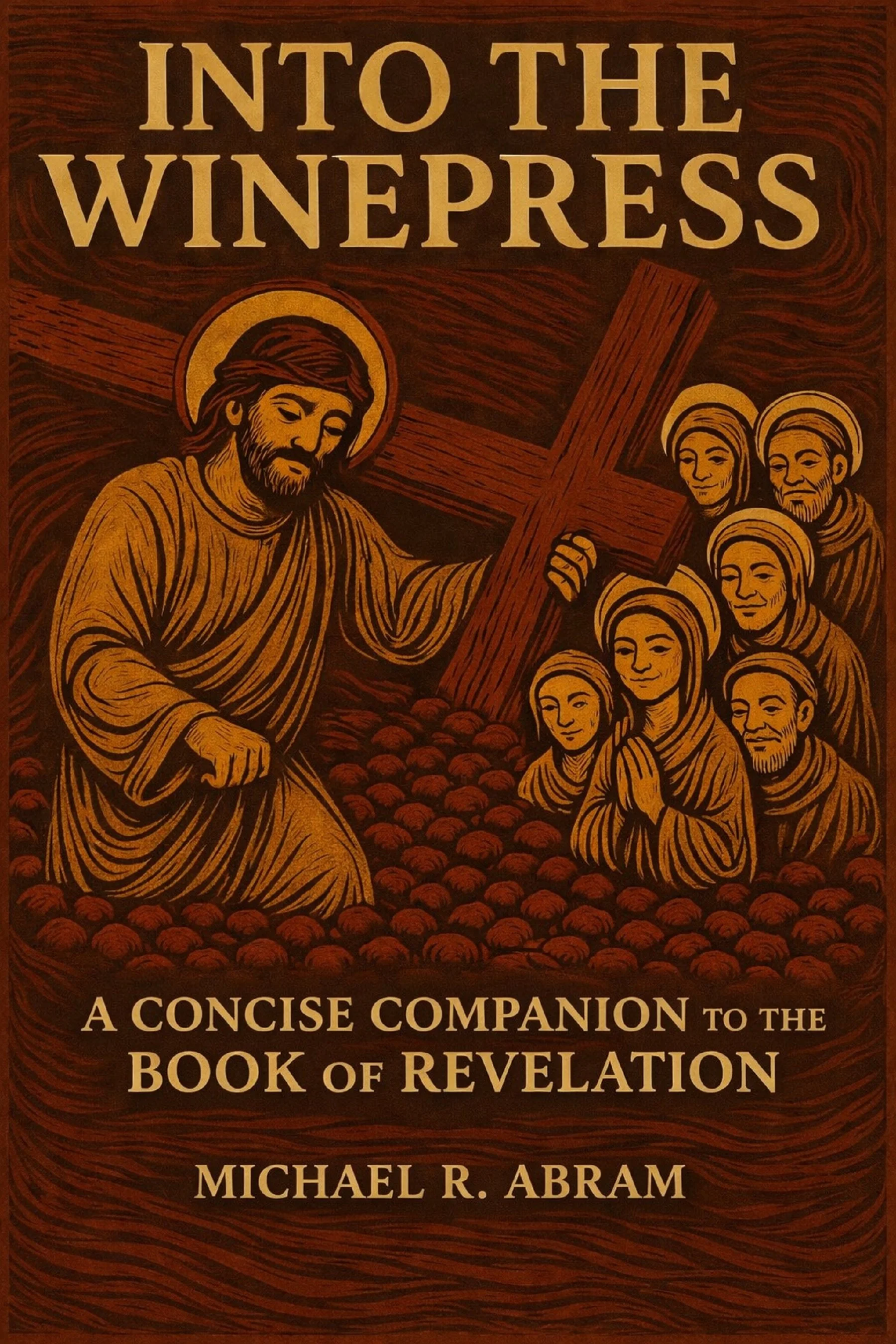
The Framework of Into the Winepress:
A Concise Companion to the Book of Revelation
Into the Winepress by Michael R. Abram is more than a commentary on Revelation. It proposes a unified framework for reading the book through the person and work of Jesus Christ. Rather than approaching Revelation as a collection of disconnected symbols or a timetable of future events, this framework seeks to let Scripture interpret Scripture, with the Cross, the Lamb, and the Kingdom providing the key to the whole book.
Rather than reading Revelation primarily as a roadmap of future world events, or as some commentators do, seeing the book as a timeless picture of good versus evil, this work explores how the book spoke to its original audience and how it continues to speak to the Church today.
The Framework at a Glance
Revelation is the unveiling of Jesus Christ.
The Cross is the interpretive center of the book.
The Lamb interprets every vision.
Revelation is rooted in the Old Testament.
Revelation primarily addresses the first-century Church.
Babylon is Jerusalem riding the Roman beast.
The winepress is first fulfilled in Christ and then in His people.
Satan is bound for the sake of the Gospel's advance to the nations.
Revelation reaches the general resurrection and judgment in chapter 20.
Revelation 21-22 returns to the mission of the New Jerusalem.
The Spirit and the Bride continue God's invitation to the nations.
Revelation ends with hope because the Lamb prevails.
Key themes include:
The victory of the Lamb through sacrificial love
The significance of Jerusalem's destruction in AD 70
The Kingdom of God as a present and growing reality
Christ's reign over heaven and earth
The binding of Satan and the spread of the Gospel to the nations
The Church as the New Jerusalem and the Temple of God
The meaning of the Millennium in Revelation 20
The imagery of the Winepress in Revelation 14
The healing of the nations through the life of Christ and His Church
These pages serve as a resource for readers of Into the Winepress: A Concise Companion to the Book of Revelation. It is meant for students of Scripture, pastors, teachers, and anyone seeking to understand Revelation through the lens of Scripture and centered on Jesus Christ rather than on fear, speculation, or sensationalism.
The Book of Revelation begins and ends with Jesus. The Lamb prevails. His Kingdom endures. His Church, united in Him continues His mission in the world.
Further Reading
What Is the Winepress in Revelation 14?
What Is the Millennium in Revelation 20?
Was Babylon the Great Jerusalem or Rome?
What Is the New Jerusalem?
10 Common Misunderstandings of Revelation
What Does “Soon” Mean in Revelation?
21 Principles to Get Before Reading Revelation
What Are the Gates of New Jerusalem
Does Chapter 21 Follow the Resurrection?
Home
What Is the Second Death?
This article summarizes the perspective presented in Into the Winepress: A Concise Companion to the Book of Revelation by Michael R. Abram. The book approaches Revelation through the victory of the Lamb, the fall of Jerusalem, the reign of Christ, and the ongoing mission of the Church.
The second death appears after the resurrection and judgment of all humanity that Jesus refers to in John 5.
It is identified with the lake of fire.
It is the fate of those raised unto judgment.
Death and Hades themselves are cast into it.
Revelation presents it as a real and serious judgment.
Yet Revelation never explicitly explains its final outcome.
The book never tells the reader what ultimately becomes of the second death itself.
The vision reaches that horizon and stops.
Rather than continuing beyond the lake of fire, Revelation returns to the vision of the New Jerusalem and the mission of the Bride.
The reader is left holding together both warning and mystery.
Most interpreters feel compelled to answer the question:
"What happens to those in the age of the second death?" The truth is, Revelation does not tell us.
The book leaves us standing at the edge of that mystery and rather than moving forward, directs our attention back to Christ, His Church, the healing of the nations, the open gates, and the continuing invitation of the Spirit and the Bride.
Further Reading
What Is the Winepress in Revelation 14?
What Is the Millennium in Revelation 20?
Was Babylon the Great Jerusalem or Rome?
What Is the New Jerusalem?
About Into the Winepress
Is Revelation About the End of the World?
This article summarizes the perspective presented in Into the Winepress: A Concise Companion to the Book of Revelation by Michael R. Abram. The book approaches Revelation through the victory of the Lamb, the fall of Jerusalem, the reign of Christ, and the ongoing mission of the Church.
For many people, the Book of Revelation is synonymous with the end of the world.
The Four Horsemen.
The Beast.
Armageddon.
The Mark of the Beast.
The final battle.
Yet Revelation presents itself differently.
The book opens as a revelation of Jesus Christ. Its purpose is not merely to reveal future events but to reveal the Lamb who reigns over history.
The question is not whether Revelation speaks about judgment.
It does.
The question is what judgment John primarily has in view.
Throughout the book, John draws heavily from the language of Israel's prophets. The imagery of collapsing heavens, darkened suns, falling stars, beasts, harlots, and burning cities comes from the Old Testament's descriptions of covenantal judgment upon nations and kingdoms.
The destruction of Babylon occupies a central place in Revelation's story. The judgment of the harlot city becomes one of the great turning points of the book. With the old order passing away, a new city emerges, the New Jerusalem.
The focus of Revelation is therefore not merely the destruction of a world. It is the unveiling of a kingdom.
The Lamb reigns.
The nations are gathered.
The Gospel advances.
The Church bears witness.
The New Jerusalem descends.
God dwells with His people.
Even Revelation's final visions direct attention toward life rather than catastrophe. The river flows from the throne. The tree bears fruit. The leaves bring healing. The gates remain open. The Spirit and the Bride continue to invite the thirsty to come.
This does not mean that Revelation ignores the resurrection of the dead or the final judgment. These realities remain essential to Christian hope. Revelation reaches the resurrection and judgment in chapter 20.
Yet the book spends far more time describing Christ's victory, His reign, and the calling of His people than it does describing the end of history.
Revelation is therefore not primarily a book about the end of the world.
It is a book about the victory of Jesus Christ and the unveiling of His kingdom.
The Lamb prevails.
Further Reading
What Is the Winepress in Revelation 14?
What Is the Millennium in Revelation 20?
Was Babylon the Great Jerusalem or Rome?
What Is the New Jerusalem?
About Into the Winepress
Is Satan Bound?
This article summarizes the perspective presented in Into the Winepress: A Concise Companion to the Book of Revelation by Michael R. Abram. The book approaches Revelation through the victory of the Lamb, the fall of Jerusalem, the reign of Christ, and the ongoing mission of the Church.
One of the most important questions in Revelation concerns the binding of Satan in chapter 20.
Many readers assume that Satan cannot be bound because evil still exists in the world. Temptation remains. Persecution remains. Sin remains.
Yet Revelation does not say that Satan is prevented from all activity.
It says that he is bound for a specific purpose.
John writes that Satan is restrained so that he might no longer deceive the nations.
The question therefore becomes: What changed through the death, resurrection, and ascension of Jesus Christ?
Before Christ's victory, the nations largely sat in darkness. The knowledge of the true God was concentrated within Israel while the Gentile world remained under deception.
After Christ's victory, the Gospel began spreading to every nation. The barriers that once confined the covenant people to a single nation were broken. The nations were opened to the proclamation of the Kingdom.
The New Testament repeatedly speaks of a decisive victory already accomplished.
Jesus declares that the ruler of this world is cast out.
He speaks of binding the strong man before plundering his house.
The apostles proclaim that Christ has triumphed over the powers and authorities through the Cross.
These passages suggest not a future victory alone but a victory already achieved.
The binding of Satan therefore does not mean that evil disappears from the world.
It means that Satan's authority to keep the nations in darkness has been broken.
The Gospel advances.
The nations are discipled.
The Kingdom grows.
The Church carries the message of Christ into every corner of the earth.
Revelation 20 portrays this age between Christ's victory and the final defeat of every enemy. Satan remains active, but he is restrained. His power is limited. His dominion is broken.
The proof is found in the very existence of the Church.
The Gospel now reaches nations that once knew nothing of Abraham, Moses, the prophets, or the Messiah.
What was impossible before Christ's victory became possible because the strong man was bound.
The Lamb reigns.
The nations hear.
The Kingdom advances.
Further Reading
What Is the Winepress in Revelation 14?
What Is the Millennium in Revelation 20?
Was Babylon the Great Jerusalem or Rome?
What Is the New Jerusalem?
About Into the Winepress
About Michael R. Abram
Michael R. Abram is a Lutheran pastor, author, Bible teacher, and former psychotherapist. He serves as pastor of Ascension Lutheran Church in Torrance, California, where he is dedicated to preaching Christ, teaching Scripture, and helping people discover the hope found in Jesus.
Michael's writing is marked by a deep love for the Bible, a Christ-centered approach to theology, and a desire to make challenging biblical topics accessible to ordinary readers. His work explores themes such as the Kingdom of God, the Cross, repentance, grace, the Church, and the Book of Revelation.
Before entering pastoral ministry, Michael worked as a psychotherapist and was a member of the National Board of Certified Counselors. His experience in both counseling and ministry has shaped his passion for helping people encounter the mercy of God amid the struggles and complexities of life.
Michael is the author of Into the Winepress: A Concise Companion to the Book of Revelation,Repentance Is in the Hug, and soon to be published, The Candy Cane Christian. Through his books, articles, Bible studies, and teaching ministry, he seeks to present a vision of Christianity centered on Jesus Christ, the Lamb who was slain and who now reigns.
Michael's approach to Scripture emphasizes the unity of the biblical story, the fulfillment of God's promises in Christ, and the ongoing mission of the Church to bring the light of the Gospel to the nations.
In addition to his writing ministry, Michael teaches regularly through Ascension Lutheran Church’s YouTube channel, where he offers Bible studies, sermons, theological discussions, and explorations of Scripture. His goal is to help readers and listeners engage the Bible thoughtfully, faithfully, and with confidence in the goodness of God revealed in Jesus Christ.
Through his books, articles, videos, and teaching ministry, Michael seeks to present a vision of Christianity centered on Christ's victory, God's enduring mercy, and the call to participate in God's healing work in the world.
"The Lamb prevails."